Understanding How Court Cases Progress in Jaipur: From FIR to Final Judgment
Learn how a court case progresses in Jaipur, Rajasthan from filing an FIR to final court judgment. Simple and complete legal guide in easy English.
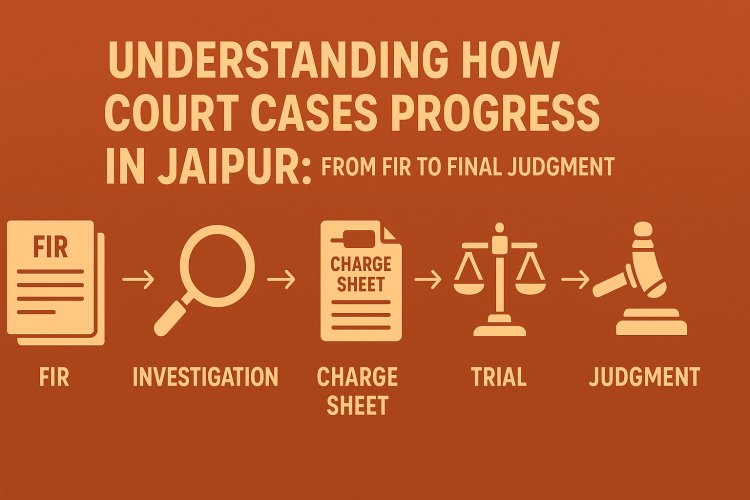
Many people in Jaipur feel confused or scared when they hear about courts and cases. Legal language can be hard to understand, and most people do not know how a case moves through the legal system. This blog is here to help you. We will explain each step in a court case, from the moment a crime is reported to the final judgment, using clear and simple English.
Step 1: Filing an FIR – The First Step
An FIR, or First Information Report, is the first step to start a criminal case.
-
Who can file an FIR?
Anyone who sees a crime or is a victim of a crime can go to the nearest police station to file it. -
Why is an FIR important?
Without an FIR, the police cannot begin their investigation. It is the legal way to start the case. -
What happens after filing?
The police write down all the details in the FIR register and give you a copy for free.
In Jaipur, you can also file an FIR online for certain crimes by visiting the Rajasthan Police website.
Step 2: Police Investigation
Once the FIR is registered, the police begin their investigation. They do the following:
-
Visit the scene of the crime
-
Talk to people who were there or saw what happened
-
Collect proof like CCTV footage, documents, or photos
-
If needed, arrest the accused person
After the investigation is over, the police prepare a charge sheet. This report includes all the findings and is sent to the court.
Step 3: Submission of the Charge Sheet in Court
When the police feel they have enough proof, they send the charge sheet to the court. The court then:
-
Reviews the charge sheet carefully
-
Decides if the case should move forward
If there is not enough proof, the court may close the case. But if the proof is strong, the case moves to trial.
Step 4: Court Hearings and Trial Begin
After the court accepts the charge sheet, it begins the hearing process.
-
The person who filed the case is called the complainant
-
The person blamed for the crime is the accused
-
Both sides are given a chance to speak
-
Lawyers from both sides present their arguments
The trial takes place in sessions courts or magistrate courts, depending on how serious the case is.
Step 5: Witness Testimonies
Witnesses are people who saw the crime or know about it. They are very important in any case.
-
Witnesses are called to court one by one
-
They speak the truth under oath
-
The court listens to what they say and checks if it matches the proof
Sometimes, cross-questions are asked by the other side's lawyer to test how honest the witness is.
Step 6: Final Arguments – The Last Words
After all the witnesses have spoken, both lawyers give their final arguments. They explain:
-
Why their side is correct
-
What the proof shows
-
What judgment they want the court to give
The judge listens carefully and takes time to study all the details.
Step 7: The Final Judgment – The End of the Case
After studying everything, the judge gives the final decision. This is called the judgment.
-
If the accused is found guilty, the judge gives punishment
-
If there is not enough proof, the accused is set free
In Jaipur, as in the rest of India, the punishment can be a fine, jail, or both, depending on the crime.
Appeal Process – If You Disagree With the Judgment
If someone is not happy with the judgment, they can appeal to a higher court. This must be done within a fixed time.
For example:
-
From Magistrate Court to Sessions Court
-
From Sessions Court to High Court
-
From High Court to Supreme Court (in special cases)
FAQs (Frequently Asked Questions)
Q1. Can I file an FIR online in Jaipur?
Yes, you can file it online for non-emergency cases using the Rajasthan Police website.
Q2. What if the police refuse to file my FIR?
You can go to the Superintendent of Police or file a complaint in the court directly.
Q3. How long does a criminal case take in Jaipur?
It depends. Some small cases take months, while big or serious cases may take years.
Q4. Do I always need a lawyer?
For court cases, it is better to have a lawyer. They understand the law and help protect your rights.
Q5. Is legal help available for poor people in Jaipur?
Yes, the Legal Services Authority of Rajasthan offers free legal help to people who cannot afford a lawyer.
Conclusion
The legal process in Jaipur may seem long, but it follows a fair path. From FIR to final judgment, every step is designed to find the truth. If you understand how the system works, you can handle any legal issue better. Always speak to a good lawyer for guidance and keep your documents ready.