Bail Process in Jaipur: Step-by-Step Guide with Advocate Insights
Learn the complete bail process in Jaipur with legal tips from expert advocates. Step-by-step guide for regular, anticipatory, and interim bail.
Arrest or the prospect of a loved one being arrested can be scary and perplexing. If you find yourself in Jaipur and are looking to know how the bail process is carried out, you've come to the right site. As experienced advocates in Jaipur, we'll outline the step-by-step bail process, your rights according to law, and how our advocate team in Jaipur can help.
What is Bail?
Bail is a legal proceeding where a person who has been arrested can be released from arrest by furnishing a surety or bond to appear in court whenever required. It ensures the accused person is free during trial time.
Types of Bail in India
As per Indian law, there are largely three forms of bail:
- Regular Bail
- Released to someone who is already under arrest.
- Applicable in both bailable and non-bailable offenses.
- Anticipatory Bail
Granted before arrest, when one apprehends that they will be arrested.
Bail Process in Jaipur – Step by Step
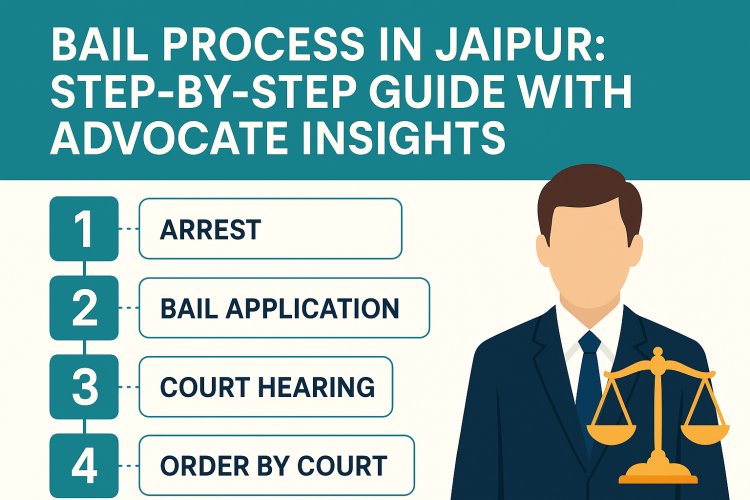
Step 1: Know the Nature of the Offence
- Bailable Offence: Police are obligated to grant bail if requested.
- Non-Bailable Offence: The Bail is left to the Magistrate or Sessions Court.
- Your lawyer will advise if this needs to be done based on the FIR and charges.
Step 2: File an application for Bail
- Where it's a bailable offence, it's filed in front of the police station or the Magistrate.
- Where it's a non-bailable offence, the application for bail has to be filed to the Sessions Court or Jaipur High Court.
Step 3: Draft application for Bail
A good bail application includes:
- FIR details
- Grounds for why the accused is not flight risk
- Reasons for why the accused should be released
- Any proof of co-operation with investigation
- Your lawyer will draft it professionally and submit it on your behalf.
Step 4: Hearing in Court
During the hearing:
- Your lawyer will make arguments for release.
- The public prosecutor may oppose.
- The judge will consider facts, nature of the crime, and chances of the accused fleeing.
5: Court's Decision
- If the judge is satisfied, bail is granted on conditions.
- You may be required to furnish surety (person who guarantees your presence) or bond money.
- Once approved, you can go but must appear at all the following court hearings.
Conditions of Bail That You Need to Obey
After bail, there are standard conditions:
- Don't travel Jaipur (or India) except with court consent.
- Attend court hearings.
- Do not meddle with evidence or come near witnesses.
- Violating terms of bail can lead to cancellation of bail.
Documents Needed for Bail Application in Jaipur
- Copy of FIR
- Arrest memo (if exists)
- ID proof of accused
- Proof of residence
Surety details (person guaranteeing the accused to follow court orders)
How Advocate in Jaipur Can Assist You
At Advocate in Jaipur, we provide:
- Professional preparation of bail application
- Anticipatory and periodic bail services
- Legal assistance in Jaipur courts
- Quick response for immediate arrests
- Guidance on court protocol and documentation
If you are the accused or a family member looking for legal help, we are just around the corner.
Frequently Asked Questions (FAQs)
Q1: Is bail available immediately after being arrested in Jaipur?
A: Yes, in bailable cases, bail can be granted at the police station. In non-bailable cases, a court hearing is required.
Q2: What is the cost of getting bail in Jaipur?
A: Legal fees vary with the case's complexity. Simple bail can be a few thousand rupees. We offer reasonable and transparent fees.
Q3: Is bail refused?
A: Yes, if the judge believes you will escape, tamper with witnesses, or destroy evidence. Your lawyer can apply for it again in a higher court.
Q4: How soon can I get bail?
A: In most cases, bail hearings are held within 24–48 hours. We attempt to speed up the process for our clients.
Q5: Can I apply for bail before being arrested?
A: Yes, anticipatory bail is so called. It is useful if you are apprehensive of a false complaint or arrest.